Blog | Reading Time 3 minutes
Non-Invasive eggshell assessment and lactic acid bacteria effects in hen performance
As global demand for eggs continues to rise, producers are extending laying cycles up to 100 weeks to meet both productivity and animal welfare goals. However, longer cycles bring new challenges and particularly in maintaining eggshell quality. Aging hens tend to produce larger eggs, but calcium deposition remains constant. This results in thinner, more fragile shells and a higher rate of downgraded eggs, leading to economic losses.
Measuring eggshell quality the simple way
To address this, a non-invasive device was developed to assess eggshell quality in commercial settings using a method based on specific gravity, measuring the egg’s density compared to water. Since eggshell density primarily determines overall egg specific gravity, this parameter correlates strongly with shell thickness and mechanical strength. Eggs with specific gravity values above 1.08 are considered high quality, while lower values suggest weaker shells. This method allows producers to classify eggs and monitor changes over time.
Because this test doesn’t damage the eggs, it can be used regularly throughout the laying cycle to track changes in shell quality over time. Microscopic studies confirm that higher specific gravity values correspond to thicker, more uniform shell structures—clear evidence that specific gravity is a good indicator of overall eggshell strength.
How probiotics can help
A 2025 meta-analysis1 examined 990 brown eggs collected over several trials to evaluate the effects of Pediococcus acidilactici CNCM I-4622 (BACTOCELL) supplementation at the commercial dose (1012 CFU per ton of feed) on eggshell parameters. This study compared hens fed a standard diet with those given the probiotic. The results were striking:
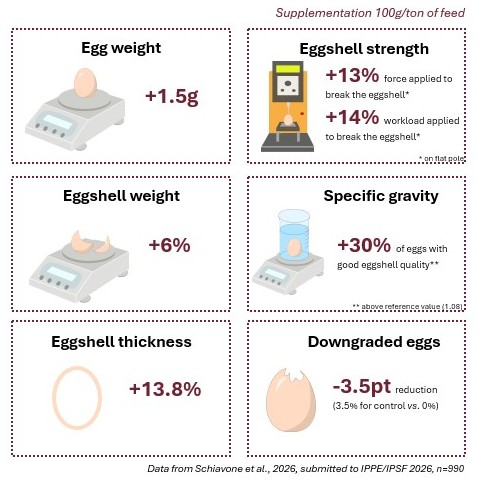
- Eggshell specific gravity improved significantly, with only 9.9% of eggs falling below the quality threshold, compared to over 30% in the control group.
- Eggshell thickness increased by 15% indicating stronger structural integrity.
- Downgraded eggs dropped to zero in the supplemented group, versus 3.5% in the control.
- Egg weight increased by 1.5g without compromising shell quality.
These findings demonstrate that Pediococcus acidilactici CNCM I-4622 (BACTOCELL) not only improves shell quality but also enhances overall egg mass—supporting both productivity and product quality (Figure 1).
Figure 1. Benefits of Pediococcus acidilactici CNCM I-4622 (BACTOCELL) for egg quality
Why it works
So how does a gut probiotic affect an eggshell? One of the main connections lies in mineral metabolism. Recent research shows that Pediococcus acidilactici CNCM I-4622 (BACTOCELL) increases levels of calcitriol and osteocalcin, two key hormones involved in calcium and phosphorus metabolism2. This leads to higher circulating mineral levels, better assimilation and improved shell mineralization throughout the laying cycle.
Supporting hens for the long term
Extending laying cycles brings clear productivity benefits— but maintaining shell quality is essential for long-term success. Measuring specific gravity provides a simple, non-invasive way to monitor shell strength. Meanwhile, nutritional tools such as Pediococcus acidilactici CNCM I-4622 (BACTOCELL) offer promising support, helping hens make the most of dietary minerals and sustain good eggshell quality throughout their productive life.
he data presented in this article are supported by scientific posters presented at major international poultry conferences, including IPPE (Atlanta) and WPC (Toronto) 3, highlighting growing scientific interest in non-invasive eggshell assessment and probiotic strategies to support laying hen performance.
References
- 1 Schiavone, A., et al. Impact of Pediococcus acidilactici CNCM I-4622 Supplementation on Egg and Eggshell Quality Across the Laying Cycle: A Multi- Trial Approach. WPC, 2026.
- 2 Shanmugam, S., Barbé, F., Park, J.H., et al. “Supplemental Effect of Pediococcus acidilactici CNCM I-4622 Probiotic on the Laying Characteristics and Calcium and Phosphorus Metabolism in Laying Hens.” Scientific Reports 14 (2024): 12489. https://doi.org/10.1038/s41598-024-62779-5.
- 3 Schiavone, A., et al. Exploring Correlations in Egg and Eggshell Quality Parameters: A Meta-Analysis of 12 Trials Covering 3,448 Eggs.
Published Feb 9, 2026 | Updated Feb 10, 2026