Blog | Reading Time 4 minutes
When the Heat Hit Hard: A Czech Dairy Farm’s Smart Solution
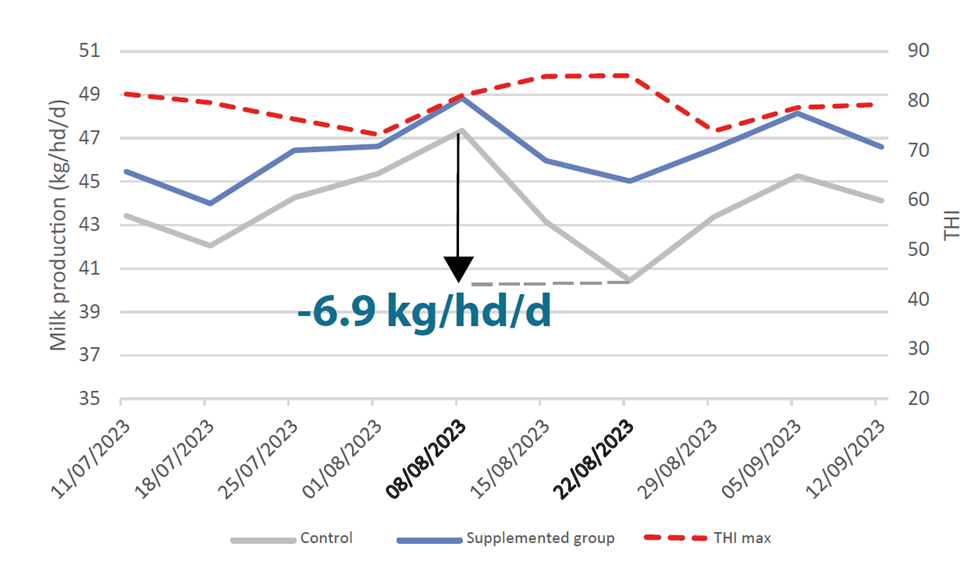
In August 2023, the thermometer was climbing toward dangerous territory at a 500-cow dairy operation in Tatenice, Czech Republic. As the Temperature- Humidity Index soared to 82 during what would become a punishing two-week heat wave, the farm manager watched his production numbers with growing concern. While control cows suffered devastating milk losses of nearly 7 kilograms daily, their supplemented counterparts lost less than 4 kilograms. The difference wasn’t better ventilation or misting systems — it was a revolutionary understanding of heat stress as a biological cascade.
The Heat Stress Challenge
Traditional approaches have long focused on environmental cooling through fans, misters, and shade structures. While these remain essential, the technical team from Lallemand confirmed what the mast advanced research had recently discovered that heat stress creates a domino effect of biological disruptions that environmental controls alone cannot address. Heat stress begins negatively zaffecting dairy cows at just 21°C, with production losses starting at 18°C, ultimately costing producers €120 annually per cow once THI values exceed 72. 1,2
These periods lead to reduced feed intake and more standing time, resulting in less milk and poorer-quality milk.3,4 Plus, there are long term side effects of heat stress that aren’t revealed until years later, including diminished mammary gland tissue development and poor calf health in offspring of heat-stressed cows.5,6 The wide-ranging effects of heat stress on dairy cows indicate this challenge involves multiple systems within the animal.
A Real-World Trial
This study began in June 2023 with a comprehensive design on a commercial 500-lactating cow herd dairy farm. Researchers evaluated the impact of a three-ingredient feed solution during the transition period under heat stress conditions in a randomly selected subgroup of 40 dairy cows.
The first ingredient targeted rumen efficiency with Saccharomyces cerevisiae CNCM I-1077, a rumen-specific live yeast strain. The second ingredient, rich in enzyme superoxide dismutase (SOD), provided antioxidative cellular. The third ingredient helped maintain optimal selenium levels by providing 1.2 milligrams of organic selenium per cow per day through a selenium enriched yeast source, equivalent to 0.05 milligrams per kilogram of dry matter intake (DMI).
The results were nothing short of remarkable. Over the first 100 days in milk, supplemented cows averaged 1.7 kg more milk per day than the control group (Figure 1). When the heatwave hit, their production losses were 45% lower (Figure 2). In addition to improved milk yields, treated cows showed lower somatic cell counts and better reproductive efficiency, requiring fewer inseminations per pregnancy. These findings make clear that this three-ingredient nutritional strategy can help enhance digestion while mitigating inflammation.
From an economic standpoint, the nutritional strategy is revealed to deliver a return on investment greater than 9:1, driven by higher productivity and reduced losses during heat stress events.
This case highlights a valuable shift in how producers can approach heat stress, not just as an environmental issue to manage, but as a biological challenge to be addressed from within. By supporting key physiological systems, producers can help animals stay more resilient through temperature and humidity spikes.
As climate extremes become more frequent, integrating targeted nutritional support into heat stress protocols is essential for maintaining both productivity and animal welfare.
Figure 1. Milk performance between control cows and cows supplemented with rumen-specific live yeast, selenium-enriched yeast, and superoxide dismutase (SOD) rich ingredient antioxidant supplement. Supplemented cows reached peak lactation earlier than the control
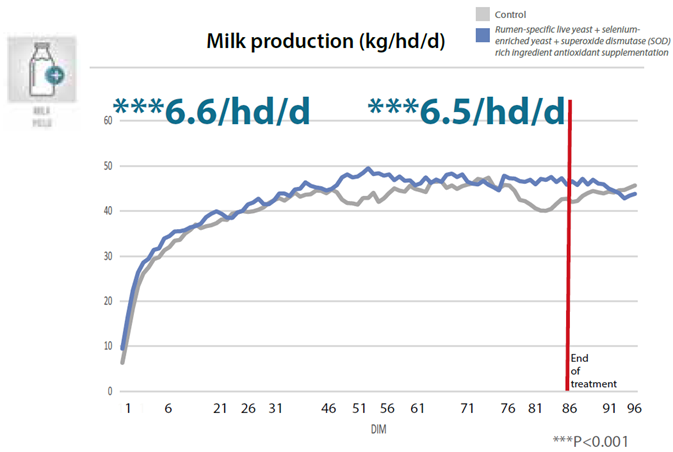
Figure 2. Milk production during moderate heat stress between control cows and cows supplemented with rumen-specific live yeast, selenium-enriched yeast, and a superoxide dismutase (SOD) antioxidant.7
References
- 1Kadzere, C. T., Murphy, M. R., Silanikove, N., & Maltz, E. (2002). Heat stress in lactating dairy cows: A review. Livestock Production Science, 77(1), 59– 91. https://doi.org/10.1016/S0301-6226(01)00330-X
- 2St-Pierre, N. R., Cobanov, B., & Schnitkey, G. (2003). Economic Losses from Heat Stress by US Livestock Industries1. Journal of Dairy Science, 86, E52– E77. https://doi.org/10.3168/jds.S0022-0302(03)74040-5
- 3Ninomiya, S., Goto, Y., Huricha, Onishi, H., Kurachi, M., & Ito, A. (2023). Lying posture as a behavioural indicator of heat stress in dairy cows. Applied Animal Behaviour Science, 265, 105981. https://doi.org/10.1016/j. applanim.2023.105981
- 4Cook, N. B., Mentink, R. L., Bennett, T. B., & Burgi, K. (2007). The Effect of Heat Stress and Lameness on Time Budgets of Lactating Dairy Cows. Journal of Dairy Science, 90(4), 1674–1682. https://doi. org/10.3168/jds.2006-634
- 5Tao, S., Orellana, R. M., Weng, X., Marins, T. N., Dahl, G. E., & Bernard, J. K. (2018). Symposium review: The influences of heat stress on bovine mammary gland function1. Journal of Dairy Science, 101(6), 5642– 5654. https://doi.org/10.3168/jds.2017-13727
- 6Skibiel, A. L., Dado-Senn, B., Fabris, T. F., Dahl, G. E., & Laporta, J. (2018). In utero exposure to thermal stress has long-term effects on mammary gland microstructure and function in dairy cattle. PLOS ONE, 13(10), e0206046. https://doi.org/10.1371/ journal.pone.0206046
- 7Data on File at Lallemand Animal Nutrition. Czech Republic, 2023 Trial Data.
Published Mar 10, 2026