Blog | Reading Time 4 minutes
Beyond Forage Inoculant Strains: What Really Drives Performance
When choosing a forage inoculant, most producers focus on the bacterial strains and their individual concentrations listed on the label. While strain selection is critical for achieving desired fermentation outcomes, it’s only part of the story. The real performance of an inoculant depends on several, often-overlooked factors that influence its effectiveness in the forage. Neglect any of these and even the “right” strains can deliver inconsistent results.
MAGNIVA Forage Inoculants are designed to excel in all these areas — combining proven strains with superior viability, stable suspension properties , packaging integrity and manufacturing consistency. This is why MAGNIVA is trusted worldwide to deliver stable, high-quality silage with reduced losses.
Viability: staying alive from mixing to sealing
Viability means more than only ensuring bacteria are alive in the package. It’s about staying viable and metabolically active throughout the entire application process:
- When preparing the solution: Once mixed and rehydrated, bacteria must stay viable in solution.
- At harvest: Bacteria need to survive long enough in the tank until all the forage is harvested.
- Until sealing in the bunker or silo: The critical window is from application to oxygen exclusion. Fermentation slows and spoilage organisms thrive if bacteria die before sealing.
The bacterial strains in MAGNIVA inoculants are selected and produced for post-rehydration survival, ensuring bacteria remain effective up to 48 hours after mixing with water.
Benefits for you:
- Faster pH drop for better preservation
- Reduced dry matter losses
- More stable silage at feedout
Mixing and suspenion: uniform application matters
Poor mixing leads to uneven coverage and inconsistent fermentation. It’s not just about mixing properly — long-term suspension stability of the bacterial strains is critical.
Not all bacteria behave the same in water. Their ability to stay in suspension, or settle at the bottom, depends on properties called hydrophobicity and hydrophilicity.
- Hydrophobic bacteria have cell structures that repel water, causing them to separate and settle faster. This is common in strains like Lentilactobacillus buchneri and Lentilactobacillus hilgardii, which tend to produce biofilm-forming compounds linked to fatty acids that don’t mix well with water.
- Hydrophilic bacteria attach more easily to water molecules, staying evenly distributed in the solution. Strains like Pediococcus pentosaceus and Lactiplantibacillus plantarum fall into this category and sediment less.
Why does this matter? If bacteria settle in the tank during harvest, application becomes uneven — leading to untreated forage zones and inconsistent fermentation. Vibrations of the applicator on the forage harvester aren’t enough to keep inoculants properly mixed.
MAGNIVA’s suspension technology ensures all bacteria stay evenly distributed for hours, delivering a consistent application and superior silage quality.
Lallemand Animal Nutrition designed MAGNIVA inoculants with stable suspension technology, which minimizes sedimentation risks and delivers a consistent application and superior silage quality. MAGNIVA inoculants are engineered to:
- Once mixed with water, MAGNIVA inoculant bacteria are rehydrated and become active.
- Regardless of the strain characteristics, MAGNIVA inoculants stay homogenously dispersed in the tank for hours during harvest, even in large tanks.
- MAGNIVA inoculants deliver uniform application across every load of forage.
Uniform bacterial coverage prevents spoilage and delivers high-quality silage from start to finish.
Consistency in production: reliability you can trust
Flow scheme of live bacteria production and quality tests at Lallemand facilities.
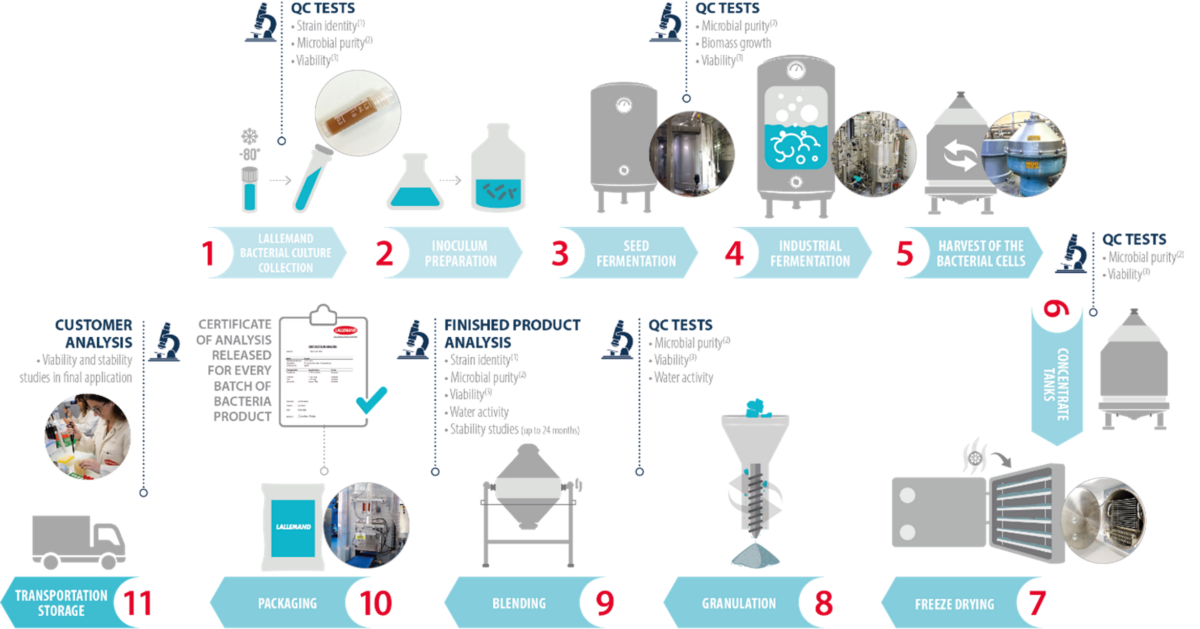
MAGNIVA inoculants are produced by Lallemand Animal Nutrition and manufactured under strict quality protocols.
- Validated strain identity and specific manufacturing processes for each bacteria strain
- Quality audits at several stages during the manufacturing process
- Standards for every batch and traceability
- Stability studies for realistic shelf-life claims
Why it matters: You get the same high performance every time — with less variability and risk.
Packaging integrity: protecting quality until use
Heat and moisture are the enemies of bacterial viability. MAGNIVA packaging is designed specifically for forage inoculants and:
- Provides an effective oxygen barrier
- Protects the product so unopened product can be stored at room temperature
- Ensures quality storage until product is delivered Benefit: Long shelf-life and peace of mind that the produce delivered is high quality.
Why choose MAGNIVA?
- Proven strains and guaranteed viability for up to 48 hours, allowing time enough for harvest, packing and bunker sealing
- Superior suspension stability for uniform application, avoiding untreated patches
- Robust packaging for maximum shelf life
- Unmatched quality and consistency backed by global quality systems
MAGNIVA isn’t just an inoculant, it’s a high-quality product designed with your farming practices in mind.
Published Mar 11, 2026