Heat Stress in Ruminants
The problem with heat stress
As temperatures climb, heat stress poses a serious challenge to ruminant health and performance. Rising temperatures, coupled with high humidity and inadequate ventilation, create an environment where animals struggle to regulate their body temperature. In response, cattle naturally alter their behavior—reducing feed intake, seeking shade, and increasing respiration. However, these coping mechanisms often come at a cost, leading to digestive disturbances, heightened inflammation, and compromised immune function. The result? Lower weight gains, reduced milk production, and overall decreased profitability.
While shade, proper ventilation, and access to clean water play a crucial role in managing heat stress, nutrition can play a key factor in supporting cattle through extreme conditions. Specific microbial solutions can help combat the negative effects of heat stress by supporting digestion, reducing inflammation, and reducing oxidative stress. By proactively addressing these challenges, you can ensure your herd remains healthy, productive, and resilient—even in the toughest climates.
How to detect heat stress in ruminants?
- Shallow breathing
- Increased respiration rate
- Profuse sweating
- Reduced feed intake
- Reduced lying time
- Decreased rumination activity
- Erratic feeding behavior
Our solutions
Lallemand Animal Nutrition has developed a proven, nutrition-based approach to support ruminants during challenging periods of heat stress. Since the rumen plays a central role in digestion and overall performance, any disruption caused by heat stress can have cascading effects on cattle health. High temperatures upset the balance of rumen microbiota, impairing digestion and increasing the risk of acidosis, while heating of silage further reduces feed intake. At the same time, oxidative stress rises, adding to the physiological burden on the animal. Our targeted microbial solutions are designed to support rumen function, mitigate oxidative stress, and encourage resilience, helping cattle maintain performance even in extreme conditions. Because when heat stress challenges your herd, the right solutions make all the difference.
Why choose Lallemand?
As a global leader in yeast and bacteria production, Lallemand Animal Nutrition has developed a comprehensive nutritional approach to address heat stress challenges in dairy cows, beef cattle and small ruminants. Our scientifically-backed microbial solutions enhance rumen function, boost immunity and improve overall animal performance. Supported by our expert team, we provide on-farm evaluations to identify challenges and offer tailored recommendations. With our proven results and dedicated support, Lallemand ensures your cattle stay healthy and productive, even in the most challenging conditions.
Heat stress by the numbers
Want to learn more about managing heat stress in ruminants?
Contact an expertLearn more
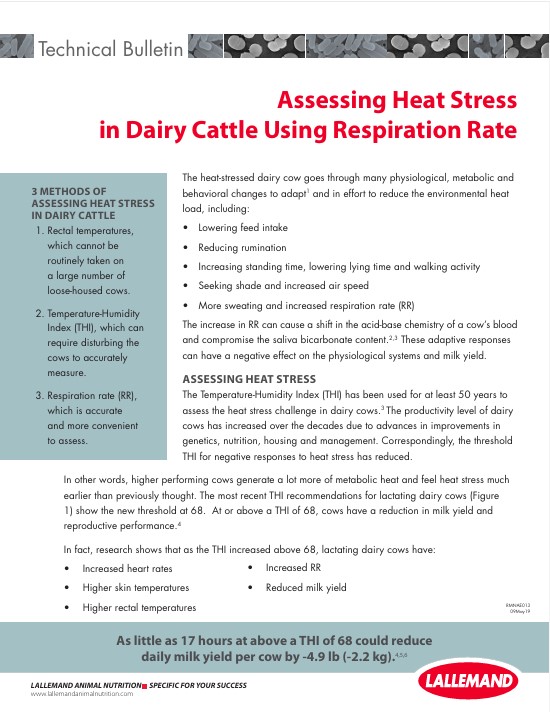
Download our technical bulletin
Learn more on how to assess and help mitigate the impact of heat stress in ruminants.
1Perdomo, M. C., Marsola, R. S., Favoreto, M. G., Adesogan, A., Staples, C. R., & Santos, J. E. P. (2020). Effects of feeding live yeast at 2 dosages on performance and feeding behavior of dairy cows under heat stress. J. Dairy Sci., Vol. 103 (1) 325 – 339
2Bach A., C. Iglesias, M. Devant and N. Ràfols. 2007. Daily rumen pH pattern of loose-housed dairy cattle as affected by feeding pattern and live yeast supplementation. J. Anim. Feed Sci. Technol. 136: 146-153
3DeVries T. J. and E. Chevaux. 2014. Modification of the feeding behavior of dairy cows through live yeast supplementation. J. Dairy Sci. 97: 6499–6510
4Lallemand Animal Nutritioninternal data. 2015. Trial performed at Texas A&M University.
5Keyser SA, McMeniman JP, Smith DR, et al 2007. Effects of Saccharomyces cerevisiae subspecies boulardii CNCM I-1079 on feed intake by healthy beef cattle treated with florfenicol
and on health and performance on newly received beef heifers. J Anim Sci. 2007;85(5):1264-73.
6 Siverson AV, Blasi DA, Corrigan ME, Higgins JJ and Oleen BE. 2010.The effect of Saccharomyces cerevisiae boulardii CNCM I-1079 on growth and health performance of receiving beef calves. Kansas State University Research Report.
7 Theurer, M. E., et al., 2019. Effect of live yeast (Saccharomyces cerevisiae boulardii CNCM I-1079) feed additive on health and growth parameters of high-risk heifers in a commercial
feedlot. The Bovine Practitioner, 53(2), 117–127. https://doi.org/10.21423/bovine-vol53no2p117-127.
8 Lallemand Animal Nutritioninternal data. 2013. Commercial farm, Switzerland.
9 Lallemand Animal Nutritioninternal data. 2014. Commercial farm, France 2014
10Haan M.M. Using Rumination Sensors to Monitor Heat Stress in Dairy Cows. Penn State Extension, Dairy Herd Management, November 02, 2016 https://extension.psu.edu/using-ruminationsensors-to-monitor-heat-stress-in-dairy-cows
11 Dr. Kung- University of Delaware
12L. K. Schüller, O. Burfeind , W. Heuwieser. Impact of heat stress on conception rate of dairy cows in the moderate climate considering different temperature-humidity index thresholds, periods relative to breeding, and heat load indices. Theriogenology. 2014 May;81(8):1050-7
13 Based on the example of 14h/day under THI >68, average THI 69, max THI 81, August in Vietnam.
Bohmanova, J., Misztal, I., & Cole, J. B. (2007). Temperature-humidity indices as indicators of milk production losses due to heat stress. Journal of Dairy Science, 90(4), 1947–1956. https://doi.org/10.3168/jds.2006-513
14 Bouraoui, R, et al. The relationship of temperature-humidity index with milk production of dairy cows in a Mediterranean climate. 2002. Animal Research 51(6):479-491
15 Hammami, H., Bormann, J., M’hamdi, N., Montaldo, H. H., & Gengler, N. (2013a). Evaluation of heat stress effects on production traits and somatic cell score of Holsteins in a temperate environment. Journal of Dairy Science, 96(3), 1844–1855. https://doi.org/10.3168/jds.2012-5947
16 Herbut, P., & Angrecka, S. (2012). Forming of temperature-humidity index (THI) and milk production of cows in the free-stall barn during the period of summer heat. Animal Science Papers and Reports, 30(4), 363–372.
17 St-Pierre, N. R., Cobanov, B., & Schnitkey, G. (2003). Economic losses from heat stress by US livestock industries1. Journal of Dairy Science, 86(SUPPL. 1), E52–E77. https://doi.org/10.3168/jds.S0022-0302(03)74040-5
18Based on 13h/day under THI >68, average THI 72, max THI 85, January in Australia, Queensland. St-Pierre, N. R., Cobanov, B., & Schnitkey, G. (2003). Economic losses from heat stress by US livestock industries1. Journal of Dairy Science, 86(SUPPL. 1), E52–E77.