Blog | Reading Time 2 minutes
Farmer experience: New approach to youngstock management gives impressive results on Lanarkshire farm
The Baillie family started feeding LEVUCELL SC, through Calf-Vantage starter pellets from specialist agricultural feed merchant Almins, as part of efforts to achieve higher growth rates to help reach an earlier calving age.
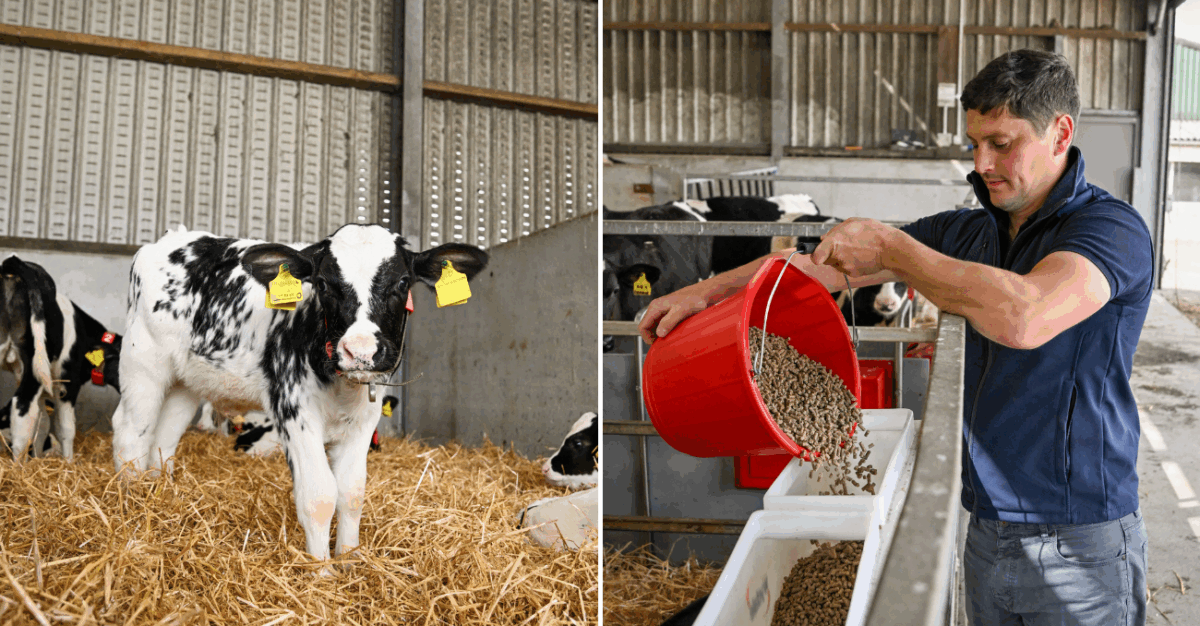
Youngstock nutrition with Levucell SC
By feeding the pellets, which contain the rumen-specific live yeast Levucell SC, their heifers are achieving a larger frame size in the first six to 12 months – leading to a reduced calving age and more robust cows as they move into their first lactation.
Gavin Baillie explains:
“We find the calves will start to pick away at the pellets from day one or two, and we feed this ad-lib all the way through to weaning.
“It’s a great complement to the milk replacer we use, and our calves are generally a higher weight and in better condition at weaning.”
The Baillies breed all their own replacements at Crumhaugh Farm, as well as selling around 50-60 surplus heifers every year – both privately and at market.
Reduced calving age and improved performance
Improvements to youngstock nutrition, as well as investment in new sheds – one for calves on milk and a rearing unit for calves from weaning all the way through to calving – have helped reduce the average calving age.
Gavin says:
“Early interventions set the foundation for the future of our milking herd, so getting this right from the start is crucial.
“We’ve reduced our calving age by six months to 24 months old, which has made a huge impact on the business’ profitability.”
The benefits of good colostrum management
He says good colostrum management also plays a key role in the farm’s youngstock feeding strategy, with heifer calves fed colostrum for the first two feeds, followed by calf milk replacer by bottle for between four and seven days, and then through an automatic feeder until they are 63 days old.
They are then weaned for the last 20 days, from 43 to 63 days, and reared in batches of between 12 and 15.
Gavin concludes:
“We pay particular attention to detail with our youngstock management, as it not only means a lot to us, but also helps us to build a healthy and productive dairy herd.”
Need some help?
Contact our teamPublished Nov 21, 2025 | Updated Feb 12, 2026