Blog | Reading Time 3 minutes
Microbial Duo Shows Promise for Sow and Piglet Welfare in Dutch Trial
In the high-stakes world of commercial pig farming, farrowing represents a critical juncture where the health and welfare of both sows and their offspring hang in the balance. Each birth carries the potential for complications, stress, and losses that can significantly impact farm productivity and animal welfare. But what if the solution lies not in traditional interventions, but in harnessing the power of beneficial microorganisms?
A Dutch commercial pig farm recently put this theory to the test, exploring whether microbial tools could enhance sow welfare and piglet outcomes during farrowing. Working with Lallemand Animal Nutrition, the strategy was straightforward yet firmly based on science: the use of two complementary microbial solutions, one aimed at supporting the sow’s internal digestive system and the other focused on shaping the microbial environment within the farrowing pen.
The Microbial Duo: Internal and External Support During Farrowing
The first intervention was a probiotic feed supplement based on Saccharomyces cerevisiae var. boulardii CNCM I-1079 (LEVUCELL SB), a specific probiotic live yeast with a proven track record for promoting gut health, stimulating feed intake, and supporting immune resilience. The second was a bacterial bedding solution containing beneficial bacteria and enzymes, formulated to help maintain a favorable microbial environment in the pen and nest, offering piglets exposure to balanced flora immediately after birth.
Thirty sows participated in the on-farm observational study with 15 assigned to the test group. Test sows received daily probiotic feed supplement boluses starting seven days prefarrowing through three days post-farrowing. Their pens and nests were treated with the bedding conditioner at strategic intervals: 200g before sow arrival, 400g at farrowing, and 200g weekly thereafter.
Farm staff monitored key indicators related to sow health and behavior, including repetitive stress behaviors, farrowing assistance needs, feed intake and udder condition. Piglet data included total born, stillbirths, pre-weaning mortality, and incidence of neonatal diarrhea.
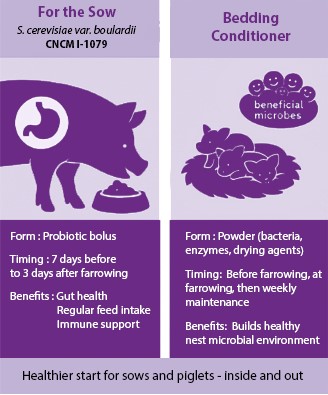
The test group demonstrated meaningful benefits compared to the control group. Sows showed calmer behavior, required less farrowing interventions (Figure 1), maintained consistent feed intake, and had visibly improved udder tone. Piglets in this group experienced a lower stillbirth rate, slightly increased live born piglets and fewer cases of neonatal diarrhea (Figure 2), with pre-weaning mortality similar to controls.
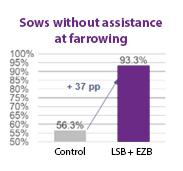
Figure 1. Sows farrowing unassisted
While not a randomized controlled trial, the results align with the documented modes of action of both microbial solutions.
The probiotic feed supplement is associated with enhanced digestion, nutrient absorption, and colostrum quality, while the bedding conditioner is known to reduce pathogen pressure in farrowing environments, supporting early-life health.
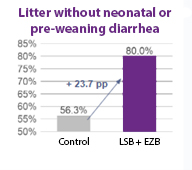
Figure 2. Litter w/o neonatal or pre-weaning diarrhea
This practical field case suggests that combining targeted microbial support for both the internal (gut) and external (pen) environment may offer synergistic benefits during the peripartum period. Additional controlled studies are needed to validate these findings and to determine how well they apply under a wider range of production contexts, such as different farm management practices, herd sizes, and environmental conditions.
Published Jan 27, 2026 | Updated Jan 28, 2026